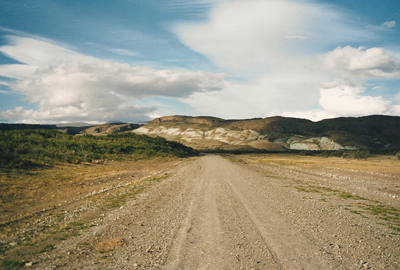
 You will be driving on paved or gravel roads in practically uninhabited
areas. The absence of the stress imposed by city transit and the beauty of the places
along the way will create an atmosphere conducive to traveling long distances with a
reasonable effort. When you plan the stages of your trip, remember that with the exception
of the paved stretches, your average speed should not exceed 60 km/hr, and 40 km/hr on
corniche roads with hairpin curves. You will be driving on paved or gravel roads in practically uninhabited
areas. The absence of the stress imposed by city transit and the beauty of the places
along the way will create an atmosphere conducive to traveling long distances with a
reasonable effort. When you plan the stages of your trip, remember that with the exception
of the paved stretches, your average speed should not exceed 60 km/hr, and 40 km/hr on
corniche roads with hairpin curves.
Whether you are driving a
town car or a 4WD, certain basic safety rules must be followed.
- Watch your speed. Most accidents on
roads with little traffic are the result of underestimating the difficulties involved.
Slow down before reaching a point in the road that is hidden from view by the terrain or
some other element. On gravel, don’t trust stretches that look good; drive on a
minimum-adherence surface. On asphalt, watch out for raised culverts and shoulder drains.
Pay attention to the wind.
-
- Drive defensively. Somebody who
thinks he has the road all to himself can suddenly pop up in that place you can’t see
completely. Stay on your side of the road whenever the visibility is poor for one reason
or another.
- On gravel, slow down to a crawl when
passing a vehicle coming from the opposite direction. This will help you keep control of
your vehicle and greatly lower the risk of breakage of your windshield and other windows
by flying rock fragments.
- If you have to overtake a slow
vehicle, keep as far away from it as possible. Let the driver know you’re there. Try
not to kick up dust and rocks.
- On backroads, don’t leave the
one you’re on. Follow the dirt roads that look like they’ve been driven most
recently. Some places can fool you, and not be as firm as they look.
- In summer it rains very little. But
if you find yourself on a wet road, keep to the high part in the middle, which is more
compacted by the traffic. Clay is very slippery; try to keep off the shoulders, which are
very soft. On dirt roads stay in the ruts if the suspension is high enough to allow this.
And if you get stuck, don’t force the motor; passing motorists will give you whatever
help they can.
- If your driving day includes a
particularly isolated stretch of road, take along sleeping bags just in case. A burner,
some water and food on board can turn out to be very useful it you have to spend a night
out somewhere.
- If you have to ford a stream, case it
out first on foot. Take care: a swift current that reaches above mid-thigh is dangerous,
and the water is always very cold. If you decide to use your winch, keep away from the
steel cable.
- Check the fuel and tires before
leaving populated areas, and top off the tank whenever possible.
- Remember to close cattle guard gates,
and don’t drive over fields unnecessarily. Help keep roads and paths clean by taking
your wastes to the next ranch or town for disposal.
- In southern Patagonia people are
valuable and few. Be courteous on the road. If you see someone asking for help –
which can turn out to only be a request that you take someone a message – stop.
What to take 
-A good road map.
-GPS are usually not enough information to drive in this roads, most of them are outdated
and probably will add more confusion. They should be only a good tool if you have the
correct location of the estancias to use it.
-Two spare tires, or at least extra inner tubes and tools if you’re up to taking the
tires apart.
-A good flashlight and batteries.
-Optional: a few simple tools, baling wire, 20 meters of 15-mm nylon rope, a collapsible
shovel, a tire pump or small air compressor.
-We do not advise taking along extra fuel in cans; it is unnecessary and risky.
Note that it is possible to get fresh information of the roads on the various
subsections of "Vialidad Provincial", at each provinces. In turn, at each stop
to supply or to overnight, check with the hosts, local people and / or people traveling
like you, the state of the roads.
If you don’t want to drive, our
Information and Reservation Center will advise you on all the different ways to get to our
member's ranches and inns, including travel agencies or transporters, that offer that kind
of service.
You will also be told how to get your own vehicle to a nearby city and drive from there,
and be advised on rental of cars or 4WDs and availability of lake cruises and other tours. |